

Most shotgun choke charts on the internet are copies of each other, and several of them are wrong — or at least, wrong for your gun.
This shotgun choke guide gives you the constriction values, explains why published charts disagree, decodes the notch markings on the tube rim, and covers two things almost nobody addresses: sub-gauge chokes don’t follow the 12-gauge numbers, and a 12-gauge tube that fits one barrel may not fit another.
The short answers, first about chokes:
- Most open choke: Cylinder — no constriction at all, just bore diameter.
- Tightest common choke: Full, with Extra Full tighter still.
- Notch markings on a Rizzini: fewer notches means tighter. One notch is Full, six is Cylinder.
What a Choke Actually Does
A choke is a constriction at the muzzle end that squeezes the shot column before it exits, holding pellets together longer downrange. It doesn’t add range in any meaningful sense. It changes pattern density at a given distance, and density is what breaks targets and kills birds.
That distinction matters practically. A Full choke doesn’t make a 55-yard bird killable that wasn’t already — it makes a 40-yard bird more reliably killable while making a 20-yard bird harder to hit and messier when you do. Choke selection is a trade between pattern size and pattern density, and the right answer depends entirely on the distance you’re actually shooting.
Shotgun Choke Chart (12 Gauge)
Nominal 12-gauge bore is .729 inch. Constriction is measured in thousandths of an inch from that bore.
| Choke | Constriction | Resulting bore | Approx. % in 30″ circle at 40 yd |
|---|---|---|---|
| Cylinder | .000″ | .729″ | ~40% |
| Skeet | .005″ | .724″ | ~45% |
| Improved Cylinder | .010″ | .719″ | ~50% |
| Light Modified | .015″ | .714″ | ~55% |
| Modified | .020″ | .709″ | ~60% |
| Improved Modified | .025″ | .704″ | ~65% |
| Full | .030″ | .699″ | ~70% |
| Extra Full | .040″ | .689″ | 75%+ |
The old rule of thumb — 10, 20, 30 for Improved Cylinder, Modified, and Full — is close enough to be useful and easy to keep in your head.
How to Read Choke Notches
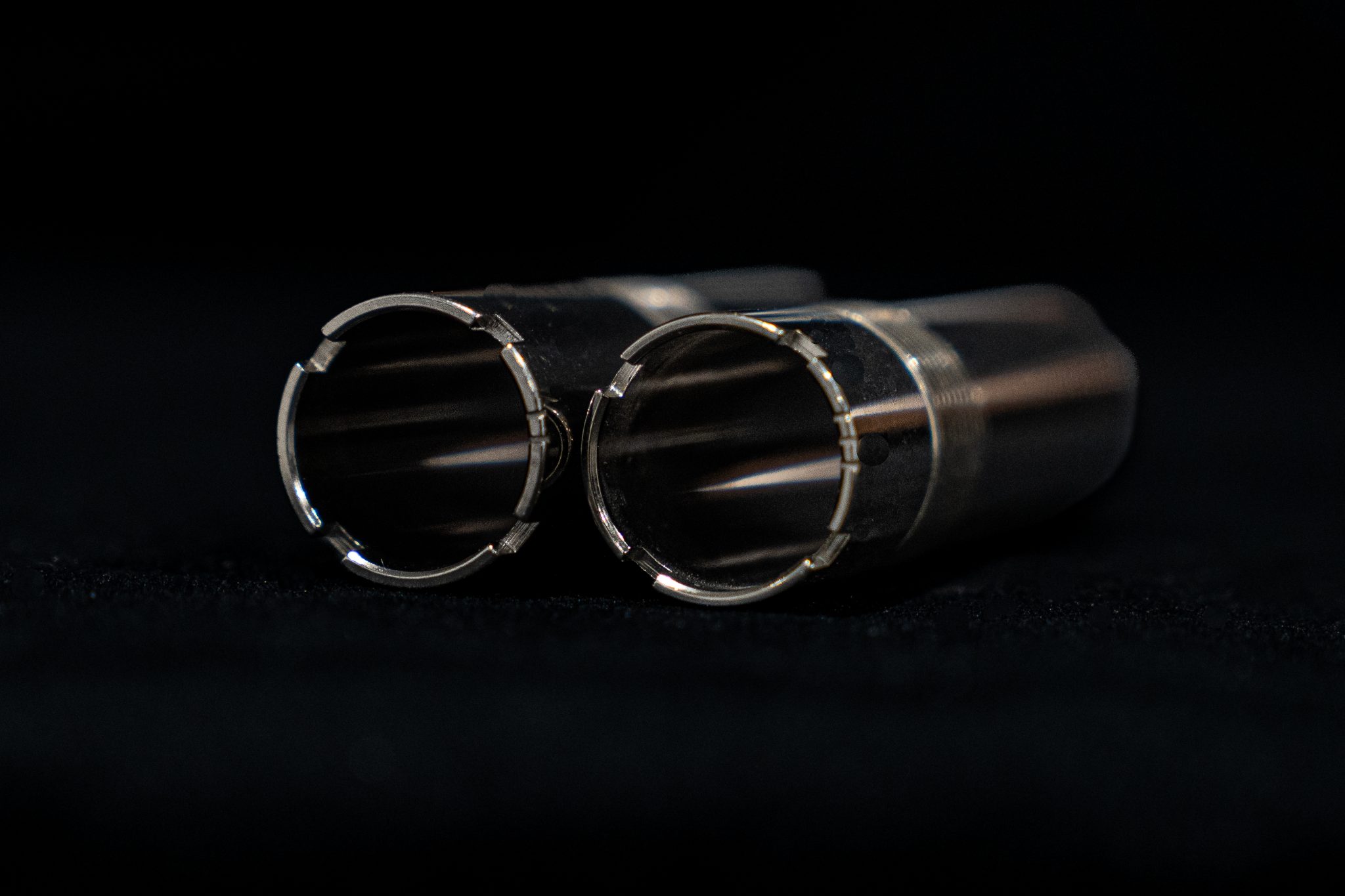
Rizzini files the notches into the muzzle rim of the tube. Pull the tube and count them straight off the end. Fewer notches means more constriction — which runs backward from what most people assume the first time.
| Marking | Choke |
|---|---|
| I | Full |
| II | Improved Modified |
| III | Modified |
| IIII | Improved Cylinder |
| IIIII + SK | Skeet |
| IIIIII | Cylinder |
| LM | Light Modified |
| XF | Extra Full |
Two grades sit outside the notch sequence entirely: Light Modified and Extra Full carry an LM or XF stamp instead of a notch count.
Pay attention to the letter stamp on the five-notch tube. Five and six notches are the one place in the sequence where a miscount actually costs you something — Skeet and Cylinder are adjacent, and a tube rim is small. The SK mark settles it. If you’re counting notches in low light at a station, read the letters first.
One caution for anyone with a mixed gun cabinet: this convention is common across Italian and Japanese makers, but a few manufacturers reverse it. Don’t carry the Rizzini reading over to another brand’s tubes without checking that gun’s manual.
If you can’t resolve what you’re holding, the Rizzini choke identification page walks through the notch and stamp markings with photographs of the tube rims. Failing that, send Rizzini USA the serial number and a photo of the rim and support will identify it.
Steel Shot: Read the Stamp
Steel is harder than lead, doesn’t compress, and patterns roughly one grade tighter than the same constriction in lead. Two consequences.
Choke one step more open than you would with lead. A Modified tube with steel patterns about like Improved Modified. Plan around that rather than fighting it.
Check the tube before you shoot steel through it. Modern Rizzini chokes rated for steel are stamped Steel Shot directly on the tube — a ten-second physical check rather than a chart lookup. Modified is the tightest Rizzini constriction rated for steel. Nothing tighter, regardless of what general industry guidance says about Improved Modified; this is a damaged-barrel question, not a performance one.
That marking is consistent across current production. On older and legacy Rizzini chokes it is not guaranteed, so an unmarked tube on an older gun isn’t proof of anything either way. If you own an older Rizzini and intend to shoot steel, contact support with the serial number before you do — that’s a cheaper conversation than a bulged barrel.
Bismuth and tungsten-matrix loads behave much more like lead and don’t carry the same restriction.
Why Published Choke Charts Disagree
Worth knowing, because you’ll notice it the moment you compare two sources.
Full choke has moved. For a long time, Full in a 12-gauge meant .040 inches of constriction. Modern plastic wads and shot collars protect the shot column well enough that .030″ now produces patterns that used to require .040″. Most manufacturers publish .030″ today, some list .035″, and older references say .040″. All three describe the same intended result.
Pattern percentages vary by source. The traditional figures put Cylinder at 40 percent and Full at 70. Some published charts run each grade a step lower. Neither is wrong so much as measured differently, with different loads.
Bore diameter is not standardized — and this is the one that actually bites. Constriction is relative to your barrel’s bore, not a nominal figure. An identically marked tube produces different constriction in a different barrel. Which brings us to the part most choke guides skip entirely.
XL Bore, Plus, and Standard: Three Families in One Gauge
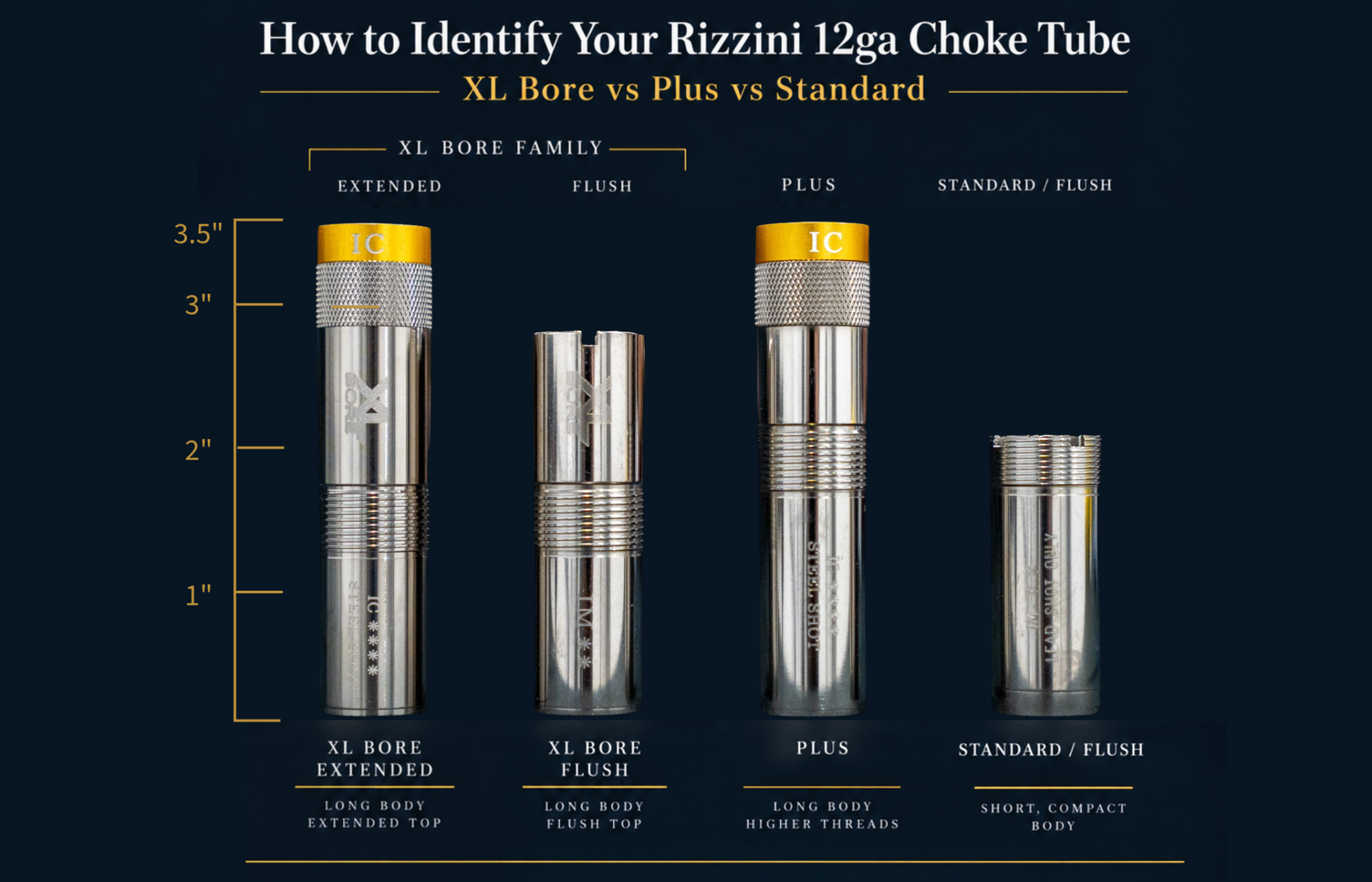
Twelve gauge alone covers three Rizzini bore profiles, and they do not interchange. A Standard flush tube will not work in barrels cut for XL Bore or Plus.
- XL Bore — long body, available extended or flush, cut for the largest bore profile.
- Plus — long body, higher threads.
- Standard — short, compact body, flush.
The notches tell you the constriction. The body tells you the family. Lay a tube next to the side-by-side body type comparison and match the length, the threads, and where the knurling sits — the differences are obvious once you have something to measure against, and nearly invisible without it.
This is also why patterning matters more than any chart. An XL Bore barrel is wider than nominal, so a tube marked Improved Cylinder delivers a different actual constriction there than the same designation would in a Standard barrel. The mark describes intent; the barrel decides the result.
If you aren’t certain which barrels you have, send the serial number to support rather than guessing — an unsuccessful thread start can damage both tube and barrel.
Sub-Gauge Chokes Are Different
This matters if you shoot 28 gauge or .410, which a meaningful share of Rizzini owners do.
Nominal bores: 12 gauge .729″, 16 gauge .662″, 20 gauge .615″, 28 gauge .550″, .410 bore .410″.
Per Briley, constriction values run effectively the same across 12, 16, and 20 gauge, but they diverge for 28 gauge and .410 once you go tighter than Improved Skeet. The reason is proportion. Squeezing a .729″ bore by .035″ reduces its diameter about five percent. Applying that same percentage to a 28-gauge .550″ bore gives roughly .026″ of constriction — which lands between Full and Extra Full in Briley’s own designations.
The practical takeaway: a 28-gauge tube marked Modified does not have .020″ of constriction, and shouldn’t. Don’t order sub-gauge tubes by 12-gauge numbers.
The .410 deserves its own note. It’s conventionally patterned at 25 yards rather than 40, and it over-chokes easily — for clays and small birds, Skeet through Modified covers most of what it’s realistically good for. Extra Full has a genuine place, but it’s a tight-pattern, sitting-target choke rather than a general-purpose one.
Rizzini stocks choke tubes in 12, 16, 20, 28 gauge and .410 bore, sorted by gauge so you start from what you own rather than from a chart. The 16 is worth a mention on its own — a genuinely good upland gauge that most makers have quietly stopped supporting, available here in five constrictions.
Choosing Chokes: Upland
Most upland birds are shot inside 30 yards, often well inside it, over a dog, in cover, going away fast. The mistake is choking too tight.
- Grouse, woodcock, close-flushing quail: Cylinder or Skeet in the first barrel, Improved Cylinder in the second. Pattern size is worth more than density at 18 yards.
- Wild pheasant, chukar, late-season birds: Improved Cylinder and Modified. These birds flush further out and take more killing.
- Mixed-bag walking: IC/Mod is the default for a reason. Rarely the perfect answer, rarely a bad one.
If you’re shooting a lighter sub-gauge field gun, err more open still. Pattern density is already the limiting factor; tightening the choke to compensate usually makes the gun harder to hit with rather than more effective.
Choosing Chokes: Sporting Clays
Sporting is a distance problem more than a presentation problem. Most shooters over-choke here too, though less dramatically.
- Close targets, under 25 yards: Skeet or Improved Cylinder.
- Mid-distance, the bulk of most courses: Light Modified through Modified.
- Long crossers, high towers, extended battues: Improved Modified. Full is more choke than most sporting presentations reward.
The argument for a full set rather than two tubes is straightforward — on a course ranging from 15 to 45 yards, changing tubes between stations is faster and cheaper than changing guns.
The Part That Actually Matters: Pattern Your Gun
Every number on this page is a starting point. Constriction is relative to your barrel’s actual bore, patterns change with shot size, hardness, wad design, and velocity, and two guns marked identically can throw noticeably different patterns with the same shell.
Shoot your gun at a pattern board at the distance you actually shoot birds or targets, with the load you actually use. Count what lands in a 30-inch circle. It takes an afternoon and it will tell you more than any chart, including this one.
If you want to do that alongside someone who can also check whether the gun fits you, find an authorized Rizzini dealer or fit center. Choke and fit get confused for each other constantly, and a gun that shoots where you aren’t looking will not be fixed by a tighter tube.
Sources cited
- Rizzini USA choke reference — notch convention, body types, steel shot ratings
- Carlson’s Choke Tubes and Trulock — published constriction charts
- Briley — sub-gauge constriction scaling by bore percentage
- NRA publications and Orvis — pattern percentage conventions (noted where they differ)
